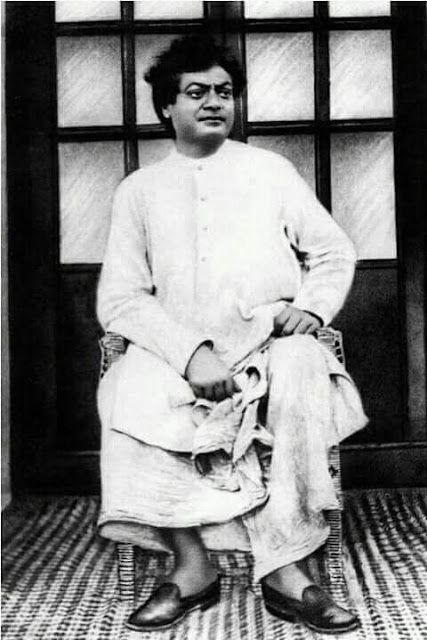
PRINCIPLE ABOVE PERSONALITY, PLEASE
If religion is based on truth, why worship divine incarnations, messiahs and prophets? Why adore them at all? Let us seek truth instead, independent of all such adoration of personality. Let principle prevail over personality. Science does it and has emerged triumphant. The Vedic dharma did it once and a wonderful civilisation emanated out of it.
If personality be eschewed from its infantile adoration, much of the fanaticism and persecution centring religion will vanish. This is what Swamiji must have wished for when he had said, "Let the lion of Vedanta roar."
Written by Sugata Bose
Photo: top -- the nameless monk in his wanderjahre of discovery of the soul of India; bottom -- the same Swami in the twilight of his life with shattered body about to give way. The interim period had been given to the world to regenerate it.
THE NEED OF THE HOUR
Very few monks have fire in their voice when they preach from the podium. Without such power lectures are in vain. It is character born out of austerity and realisation of the principles preached and an uncompromising life lived in consonance with it that generates the fiery power that can run through the nerves of the audience and set them aflame to transform them for good. Such men are few and far between although the demand of the hour for such is inordinately high. We need a renaissance in our spiritual culture that must retrace its steps to the pristine principles enunciated by Ramakrishna and Vivekananda.
Written by Sugata Bose
THE HINDU IS RIGHT AND THE HINDU IS WISE
The Hindu has a pragmatic sense of God. He does not carry his whole bank balance to office but just the required sum in his purse. So, he is happy to worship the Avatar and the concise version of God in His image and cares not to befuddle his brain with thoughts of the Infinite right away. After all the water in the cup and the water in the sea are the same water. And the Hindu knows it. He also knows that there is no other way to know God save through the anthropomorphic way, of seeing the sea in the saucer, of sensing the atmosphere in the puff of air inhaled.
The Hindu is practical and the Hindu is wise. He has made bread and butter of philosophy while the tall talkers of monotheism gasp for breath in the void of their imaginary infinitude which they term God. The Hindu has solved the dimensional problem, harmonising differences in magnitude in the zero he has discovered and attaining peace in realising that the small is but the big if in kind they agree, notwithstanding differences in degree. After all the standing figure is the lying figure with height transforming to length while volume and mass remain conserved.
Written by Sugata Bose

YOUR SWAMIJI ... 1
Have you heard of Swami Vivekananda? Yes? But have you heard of Narendranath Datta? I am sure most of you have not but some of you may have. Well, this little boy is the subject of our story which I shall begin narrating to you, children, from today.
YOUR SWAMIJI ... 2
The Dattas were an affluent family who lived in North Kolkata at a place called Simla or Simulia. Rammohan Datta was the grand patriarch who had thrived in the legal profession and amassed a fortune. His sons, Durgaprasad and Kaliprasad, grandson, Vishwanath, were the immediate ancestors of Narendranath who grew up to become the world renowned monk, Swami Vivekananda. Durgaprasad excelled like his father at law but renounced life to become a monk at age between 20 and 22 after fathering a son. So, Kaliprasad became the head of the Datta family and as he was not upto earning a living, the Dattas' fortunes started declining steadily.
YOUR SWAMIJI ... 3
Durgaprasad renounced between age 20 and 22. Shyamasundari, his wife of valorous virtue, took up to rearing baby Vishwanath amidst great difficulties as Kaliprasad was not sympathetic to their lot. When Vishwanath was three years old, Shyamasundari went on pilgrimage to Varanasi by boat. En route the playful baby fell into the Ganga. Instantly the mother, forgetting the fact that she knew not how to swim, dived into the surging waters and gripped the baby, so hard that it bore the mark for several years. A fellow pilgrim and a resident of the Datta household, indigenous physician Umapada Gupta, diving suit, rescued them and hauled them overboard. The pilgrimage carried on and holy Varanasi was reached in the fullness of time.
YOUR SWAMIJI ... 4
Varanasi. The Ganga flowing by since time immemorial, sanctifying this city of Shiva. Thousands of temples of all kinds of deities thronging to get the worship of devotees who flock by the millions. The most ancient city of the world, dating 5000 years, now welcomed Shyamasundari and her little boy, Vishwanath.
YOUR SWAMIJI ... 5
Shyamasundari went on her daily rounds of the temples in Varanasi. One day on her way to the seat of Lord Vishwanath, she slipped on the way and fell unconscious. A monk passing by picked her up, laid her on the temple steps and brought her back to her senses. When she came to her own she was astonished to behold her own husband as her rescuer. Overwhelmed by sudden emotion, the couple, now renounced to the world, went their way.
YOUR SWAMIJI ... 6
Durgaprasad visited his hometown Kolkata once, probably en route to the Gangasagar, and put up with a friend. He requested confidentiality but the message leaked and he was accosted home by his family members where he was confined to a room with food and refreshments for three days. The monk, locked up thus, touched neither food nor drink for the said period and his relatives, fearing the worst, unlocked the door. The monk quietly slipped away thereafter and was never seen again. Later it was rumoured that he had become the head of a monastery in Varanasi but nothing could be ascertained with any degree of certitude. Vishwanath in his youth visited Varanasi in search of his father but failed to trace him. Thus disappeared the monk of sterling spiritual strength from the horizons of the Datta household till his gene reappeared in his redoubtable grandson, Narendranath, whose monastic future bore unmistakable marks of his predecessor, Durgaprasad.
YOUR SWAMIJI ... 7
Vishwanath, deprived of paternal care and patrimony, grew up under the loving care of his mother, though amidst straightened circumstances. But a worse fate was awaiting him. At the age of ten he lost his mother. Now, orphaned and ill-treated by uncle Kaliprasad, Vishwanath took to the hard way of labouring through to life's success. He became proficient in several languages - Bengali, English, Persian, Arabic, Urdu and Hindi, and also learnt a smattering of Sanskrit in a classical Sanskrit Tol. He studied history in-depth, astrology enough to be able to cast the horoscopes of his children, and studied music under an Ustad. After completing secondary education he attempted business, failed and apprenticed himself under Mr. Temple, a British attorney. In 1866 he qualified as an attorney and set up shop with one Ashutosh Dhar under the name 'Dhar and Datta'. Soon his legal proficiency earned him independent status as attorney-at-law in the Calcutta High Court where his practice took off.
YOUR SWAMIJI ... 8
Vishwanath's fame as a legal practitioner spread far and wide and he had to travel extensively all over India to meet up with his clients' cases. His income soared and so did his expenditure as he lived lavishly and gave liberally to seekers in need. His charity earned him the sobriquet 'Daataa Vishwanath' or 'Philanthropist Vishwanath'. He refused none and gave to all who were in need and even to some indolent relatives who abused his magnanimity by indulging in intoxicants with his money. Vishwanath lived for the day and saved nothing for the morrow, steered by the conviction that his sons, if well fed and well educated, would be able to make their way in life but that the hapless ones he helped were too weak to help themselves and, hence, needed help. The large heart of Vishwanath bled for all, perhaps so conditioned by his own stressful childhood in financial and psychological distress under an unsympathetic uncle. Anyhow, this was how he was and this liberal largeheartedness he bequeathed to his beloved sons, Naren in particular who even imbibed sterling virtues of head and heart from his mother Bhuvaneshwari.
YOUR SWAMIJI ... 9
Well-versed in the Holy Bible and the Dewan-i-Hafiz and well acquainted with Hindu, Islamic and European culture and customs, Vishwanath had a universal outlook on life and living. Progressive in thinking but guarded in giving into new-fangled socioreligious movements of the day, Vishwanath was a precursor in some sense to the modern Hindu man as yet germinating in the womb of time. His illustratious son would set the seal on the mould that was thus being cast on the dawn of this new awakening of the ancient spirit whose crest bore the personality of Ramakrishna. But we are fast-forwarding the narrative thus which we must desist from. As of now we must remember that here was Vishwanath, caught in the cross-current of the three aforementioned cultures out of which he was fashioning his own perspective, his world-view, and setting them to print in the form of three books which he authored, namely, 'Shishtaachaar Paddhati' ('Canons of Good Conduct') in two volumes and a novel in his vernacular Bengali, titled 'Sulochanaa'. Vishwanath supported Vidyasagar's crusade for the remarriage of widows but refrained from participating directly in such social movements, busy as he was with his intensive legal practice. One more pointer about Vishwanath - he was an agnostic of sorts, irreverent of superstitious religious practices that kept people down but was never irreverent towards sublime principles of spiritual and moral thought which he tried to put into practice in his own life by way of alleviating the misery of the hapless ones he came across in his life's thoroughfare. This was then the father of the future Vivekananda.
YOUR SWAMIJI ... 10
Hardly anybody recalls the name of Swami Vivekananda's maternal grandfather or the maiden surname of Swamiji's mother. That she was Basu and bore in her bloodstream the kshatriya valour of this clan from erstwhile Kannakubja (Kanauj) is forgotten in the name Narendranath Datta. But the great prophet bore in his arteries that strong blood which made him revolutionise India into rebellion against the British and break the citadel of global colonialism. Narendranath's grandfather on his mother's side was Nandalal Basu of Simla, North Kolkata, and his only daughter Bhuvaneshwari Basu, married to Vishwanath Datta, was his mother. Bhuvaneshwari, born to wealth and high culture, was aristocratic in temperament devoid of its vices and it was from her that the boy Bileh absorbed in his mother's milk that nobility of character that set him out as unique in the world of men, so much so that in later years in Paris he was mistaken to be a prince by a hotel boy who could not be convinced otherwise. Well, Bhuvaneshwari, wedded to Vishwanath at ten, mothered Narendranath as her seventh child and her first surviving son. But more of that later for here we are in the midst of the maturing of a modern Madonna for who else could hold in her womb the one whose eagle eye holds countless universes in harmonic play ? Let us dwell on this girl, Bhuvaneshwari.
YOUR SWAMIJI ... 11
Bhuvaneshwari was wedded to conjugal life at the early age of 10 as was the custom in those days prior to the passing of the Age of Consent Bill. She bore fruit several times of which three died in infancy and she remained without a son yet. The pious girl prayed and fasted and exhorted an aunt living in Varanasi to offer prayers at the seat of Vireshwar Shiva in Kashi. Accordingly, every Monday special offerings were made there and they were reinforced by Bhuvaneshwari keeping her vigils and fasts here in Kolkata. The channel was thus being set up for the golden road that was to connect the ancient city and this modern metropolis, and when the pathway had been fully laid, Bhuvaneshwari dreamt of the meditative Shiva awaking from his seat of concentration and announcing His resolve to be born as her son. In ecstatic joy Bhuvaneshwari awoke from her divine slumber and fell prostrate at her chosen deity's feet, the adorable Umanath, who she had so ardently worshipped all these years. Bathed in tears of bliss Bhuvaneshwari felt saturated with the Lord's grace. Soon she felt that she had conceived.
YOUR SWAMIJI ... 12
12 January, 1863. Makar San°kraanti Day. Millions of pilgrims were assembled at the estuary of the Bay of Bengal to offer oblation to the Highest when heaven itself descended to earth in the form of the infant who was to steer humanity onto a new course, setting the stamp of his divine personality on the unfolding age of light that was now waiting in the wings to emerge in full flight. The forest of this world was ready for this fresh efflorescence and the bud blossomed from the womb of Bhuvaneshwari six minutes before sunrise to send a thrill of joy through the Datta household. A son had been born, Bhuvaneshwari's long-cherished dream, the parched earth's long longing, humanity's hope of redemption from its decadent state. Vishwanath grew so blissfully excited that his charity broke all bounds this hour as he started giving away to whosoever came his way anything he could lay his hands on. Finally, he had given away the very clothes he was wearing, a la Emperor Harshavardhana of old, and had to borrow his wife's saree to cover himself. The boy was named by the mother Vireshwar after the deity who had fulfilled His promise to be born as the pious supplicant's son. Soon lingustic aberration changed it to Bileh and so was how the future Vivekananda used to be called by his loving mother even in his twilight years in Belur Math when the old lady proudly strutted about the precincts of the monastery in search of her son, calling loudly, "Bileh ! Bileh !" and the son would emerge from his room and descend the stairs to fall prostrate at his beloved mother's feet. But we have much advanced in our narrative in our flight of fancy and must revert to its fresh beginnings, for we have a full lifetime to cover. Right now the baby cries in its mother's arms. Or, does it blink in wonder at the strange world around ?
YOUR SWAMIJI ...13
The boy was Bileh at home, to the world Narendranath, a name that was, as if by divine sanction, to set its stamp upon the very world. An exceeding force seemed to well up within him making him irrepressibly naughty, playful, self-willed and at times given to fits of violent temper when he would even rampage his way through whatever he could lay his hands on, furniture et al. Mother Bhuvaneshwari, driven to her wit's end, would then in exasperation exclaim, "Alas ! I had prayed to Shiva for a son but He has sent me one of His demons instead." No amount of censure, threat or even inducement would work with the turbulent child and he had to be manned by two nurses constantly to keep him in a semblance of check. Finally, Bhuvaneshwari discovered a unique way of tackling the situation. When Bileh was in one of those moods, she would pour water over his head profusely while chanting the name 'Shiva'. She would further induce fear in him saying, "If you are naughty thus, Shiva will refuse you entry into His abode, Kailash, again." Like magic this would work and calm the boy and he would be his bonny self again.
YOUR SWAMIJI ... 14
Now two very important features of the baby Bileh's personality were (a) his easy acceptance of all and sundry as his own and his consequent easing into anyone's arms who extended them to hold him, and (b) his submission to gentleness shown to him by any and equal revulsion of harshness by any in interaction with him. These traits manifest in the baby are worth meditating on as we attempt to unravel not only the secrets of the child-mind universally but also as we seek to plumb the divine depths of the future Swami Vivekananda, now, though, right in bud.
YOUR SWAMIJI ... 15
Grandfather Durgaprasad's gene was very much manifest in Narendranath from early boyhood. He had a liking for mendicant monks and would give away alms freely to them. But he was just a small boy. What did he have that he could give? Well, he gave away his first piece of dhoti from round his waist to a sadhu. Likewise he gave away whatever he could lay his hands on to these pilgrims of the Spirit so much so that when any such appeared at their door he had to be kept confined in an upper storey room to keep him in bounds. But such ploys failed when Naren flung through the open window whatever was available to him in his cell to monks passing by on the road below. Such affinity for the renunciates was early signal of things brewing up in the heart of the Divine Mother orchestrating things from behind that was to fashion Narendranath's fate. A vast force was accumulating in the child that was to inundate the world in the days to come. And in this prophetic mission of his he was to bear not only the blessings of his divine Master but those of each and every monk who he gave and who in their turn blessed him silently from the depths of their hearts.
YOUR SWAMIJI ... 16
Ebullient as he was, Naren was given to pranks galore. One of these was to tease his sisters and, when chased, to seek refuge in the open drain and makes faces and remarks such as 'Catch new! Catch me !' from there, knowing full well that they would not dare follow suit into the dirt where he lay. The future Vivekananda was worshipped in Kashi Kedarnath Temple as Shiva, was reverenced by a passing monk in the Himalayas as Shiva and venerated by many including his brother disciples like Swami Brahmananda as the same Lord Ascetic. In that sense he was Pashupati, the Lord of all animals, and to this effect he showed early signs by way of his affinity towards his pet animals. Lifelong this relation remained, even in his advanced years in Belur Math where he had quite a number of pets. The boy Bileh had a monkey, a goat, a peacock, pigeons, guinea-pigs, the family cow and his father's horse to keep him company. He with his sisters would bedeck the cow with garlands, mark her forehead with vermillion and reverence her on festive occasions. This easy relation with the dumb animals must have been a formative influence in the making of his future deep sympathy with the muted millions of his benighted motherland.
YOUR SWAMIJI ... 17
Naren's bosom buddy was his father's coachman. He spent hours in the company of the syce at the stable and nursed ambitions of one day becoming a syce himself. His intimacy with the syce drew the twain into close communication and imperceptibly lay open Naren's mind to whatever the former had to say to him. At noon every day the little boy was privy to the women folk's rendition of the Ramayana reading and with rapt attention he absorbed the epic tales which gradually endeared him to Sita and Rama. Soon he had bought from the market idols of the divine couple and with the help of a friend installed them in the attic and with floral offerings worshipped them to his child heart's content. This went on till the syce, himself victim to an unhappy marital life, criticised the very institution of marriage vehemently before Naren, thereby making the boy brood on its futility. He could no more now accept the fact that his divine ideals, Sita and Rama, were also one such married couple and in tears confided his predicament to his mother. Bhuvaneshwari instantly assuaged his grief by asking him from then on to worship the ascetic of ascetics, Shiva, instead. Naren was pacified but could not reconcile himself anymore to being in the proximity of Sita and Rama. Accordingly, he rushed to the attic, picked up his beloved idols and in the dark enveloping evening walked to the edge of the terrace railing and hurled down the images onto the road below. His ideal had been shattered, now he smashed the idols representing them. Next day he bought from the market a clay image of Shiva and began afresh his meditation on the Lord. However, Sita-Rama remained forever etched in his memory as his boyhood's first divine love and became a significant formative influence in his life and a perennial presence in his monastic life as well. Many years later he called every Indian the child of Seeta, that holy woman who unmurmering bore all her suffering in her all-encompassing love for her beloved husband, the divine Rama.
Written by Sugata Bose
(To be continued on some such dawn of renewed inspiration.)
A BINDING DUTY FOR US
Hindus who convert to Islam or Christianity have a very flawed understanding of these two religions and a very poor understanding of their own owing to proliferating crass religious culture. Study Ramakrishna-Vivekananda to avoid this precipitous fall unto alien religiocultural perversion.
The monks of the Ramakrishna Order and the devotees of the same have a special duty in preventing the perversion of Hindus to Islam and Christianity, and this cannot be brought about by pandering to the vanities of these two proselytising faiths that are doctrinally enjoined to convert the entire world to their own fold, especially Islam which cannot tolerate the polytheistic, idolatrous Hindu and must destroy his religion and impose itself.
Written by Sugata Bose
ON THE EVE OF THE CONCLUSION OF THE YEAR-LONG CELEBRATION OF THE 125TH ANNIVERSARY OF THE RAMAKRISHNA MISSION
Why read from writing displayed on a screen in front? That is deception. Rather read directly from a notepad in view of the camera. That is simplicity, practice of spiritual rectitude.
Sri Ramakrishna's great saying 'Taka mati, mati taka' you for obvious reasons forgot to mention. Also, 'Satya kathai kalir tapasya.'
Swamiji had cautioned the Mission monks against advertising their achievements. His motto was silent work. Today, in the name of communication of news of welfare activities to the public, the executive authority is much given to that very advertising and self-proclamation that was forbidden by Swamiji.
Truth in perfection of observance has been forsaken in the Ramakrishna Mission ever since the day Tulsi Maharaj's (Swami Nirmalananda's) name was erased from its publications and public discourse by a systematic design. This has not been in keeping with the principle 'Satya kathai kalir tapasya.' The Mission mentions only 16 direct monastic male disciples of Thakur, leaving the 17th one, Tulsi Maharaj, out, when the truth is that Thakur had 17 direct disciples. This is amply evident from the earlier publications of the Mission. Read Brahma Gopal Dutt's book 'Swami Nirmalananda---A Disciple of Sri Ramakrishna---A Focus on Facts and Facets' to come to a comprehensive understanding of the actual truth as opposed to the projected untruth.
Politics? There is no active involvement of the Mission in actual politics, true, but there is an increasing hobnobbing of the highest executive authority in the corridors of political power which is an eyesore. Political speeches have been given from the Belur Math precincts twice, once by the Chief Minister and once by the Prime Minister with the Mission remaining mute over the spectacle on grounds of fabled Indian hospitality.
Swamiji wanted democracy in time in the Mission but overtime it is being perceived even by the public that there is an increasing concentration of power in the hands of a select few of the trustees with absolute paramountcy of the Chief Executive, the General Secretary, who is unduly eulogised by all and sundry within the Math's monastic brotherhood openly to the shame of the Mission's glorious tradition. Such sycophancy is contradisposed to genuine spirituality.
There is a tightening of executive control today, true, but a slackening of spiritual values and a deflection from original ideals and intent which form the bedrock of Thakur's Order. This is a dangerous trend which, if unchecked and not rectified forthwith, could derail the Mission's movement despite pompous proclamations about Swamiji's prophecy of the Mission surviving 1500 years of glorious growth that will inundate the world with a spiritual tsunami resurrecting humanity and setting it on a divine evolutionary track.
The Mission's growth and welfare activities have been glorious over the last decade, true, but the payment given to its employees, from what one gathers, is exploitatively low. This needs redress as well. The Mission should set standards of non-exploitation of labour rather than give in to capitalist culture despite it being overwhelmingly well-funded today.
These are well-meaning observations made by one who genuinely deems the Ramakrishna Math and Ramakrishna Mission to be the kohinoor in the country's crown and fervently hopes that the dazzling diamond is not lost to marauders like the one in history which now adorns the plunderer's crown. All glories ahead to the deeds of the Holy Trinity of Thakur-Ma-Swamiji who for sure will salvage the situation and set their organisation right. At least one hopes so unless, of course, as prophesied by Thakur, he reappears on earth to set up a new Mission yet again whose life will last the remaining term of 1500 years.
P.S. When Swami Atmasthananda, the 15th President of the Ramakrishna Order, died, the West Bengal Government characteristically honoured him with a 21 round gun salute from 9.00 p.m. to 10.00 p.m. within the Belur Math precincts near Swamiji's Temple which broke the silence of Thakur's hour in repose after his dinner and sullied the sanctity of the hallowed grounds trodden by Holy Mother, Swamiji, Raja Maharaj, Mahapurush Maharaj and a host of other spiritual luminaries. Why was permission given for such a violent tribute that broke the silence of the night, disturbed the birds sleeping in their nests, causing them perhaps in fright to suddenly take to flight, thereby losing track in the deep dark night and coming to grief? The gun is an instrument of violence and certainly not a holy tool used to honour spiritually illumined souls in memoriam. Why then this sacrilege of the Belur Math in May, 2017? Will this be the order of the day then even in the Order? These are ruminations worthwhile one hopes the misdirected authority today deems worthy of attention. 🕉
Written by Sugata Bose
P.S. : Why delete comments that you find critical of your unspiritual stance like you have deleted mine? This is why religion becomes static and an agency of control by the ruling dispensation. Let criticism flourish. Otherwise, where will you get another Vivekananda? How would you have got the original Vivekananda, your founder, were he not constructively critical of the dispensation then that inspired him to found the Order whose 126th anniversary you are about to celebrate tomorrow ?
REFLECTIONS ON THE SANATAN DHARMA AND THE HINDU POLITY ... 1
We, Hindus, worship the cow and do not eat it. That is why we are the most civilised spiritual race in the world and the least violent. Our problems are internal, limited to within our complex social fabric where indeed we find tensions and inequalities, sometimes even of a vicious kind. But we do not extend them to beyond our boundaries. We do not persecute other peoples, other races, religions, cultures. We are a peace-loving people content to solving the riddle of existence rather than busying ourselves in cutting the throats of people who differ with our religious realisations, beliefs and practices. We have learnt from ancient times the sanctity of life. Hence, we are non-violent. But when infringed upon too much, we also know how to deal a telling blow in self-defence.
Our dharma differs from the Abrahamic concept of belief-bound faith. It is based on the discoveries of spiritual principles by spiritual scientists or seers called Rishis. These principles are beginningless and endless, subtle as they are and transcending time. Hence, their conglomerate collection called the Vedas are also beginningless and endless and are co-equal with God in some sanctified sense, although not absolutely so, God in the Vedic sense being the highest development of these ideas and the unmanifest-manifest Being.
Our dharma is a tradition in much the manner of the scientific tradition. As such no dogma binds it or its adherents. Investigation into truth in all its relative complexities and its absolute transcendence is its life force and rational scepticism backed up by intuitive insight its method. Where it goes a step further than science is that dharma keeps its doors of investigation open to both the external and the internal world. Modern psychology also does somewhat the same but does not go as deep as the psychology of the Sanatan Dharma. The latter dives deep into the internal world of man and attempts to arrive at the very root of consciousness which is also the root of the Being, dubbed the Brahman in the universal sense and the Atman in the sense individual. Essentially, though, Atman = Brahman, for in transcendence of the mathematical web of Maya there is but the solitary existence, call it by whatever you will.
Written by Sugata Bose
Photo: Swami Madhavananda, ninth President of the Ramakrishna Math and Ramakrishna Mission, disciple of Holy Mother Sri Sarada Devi who had, when apprised of the young Nirmal's (Madhavananda's) academic brilliance and ascetic propensities, famously compared him to a tusker's tusk rimmed in gold. She had in delightful benediction exclaimed, "ও বাবা, এ যে দেখছি হাতির দাঁত সোনা দিয়ে বাঁধানো !"